
Medical Misses: Why the Establishment Takes Decades to Notice What Works

From citrus to clean hands to ulcers—and now, cognitive decline—medical orthodoxy has always resisted progress before claiming it was obvious all along.
Physicist Max Planck once observed that “science advances one funeral at a time.” In medicine, the timeline is even slower, advancing only after vehement denials protecting the status quo at the expense of suffering patients.
The pattern is remarkably consistent: an innovator discovers the root cause of an intractable disease, demonstrates patients get better, and presents the findings to the medical community. The community responds with mockery, eye-rolls, and a stern demand to stick to conventional wisdom—even when conventional wisdom isn’t helping anyone.
A quick tour through the medical archives proves that today’s common-sense breakthroughs began as yesterday’s professional heresies.
The Medical Hall of Shame: A History of Dragging Feet
Medical progress has never been a tidy, graceful, eagerly received handoff of evidence. More often, it resembles a protracted custody battle where the establishment refuses to admit it backed the wrong theory.
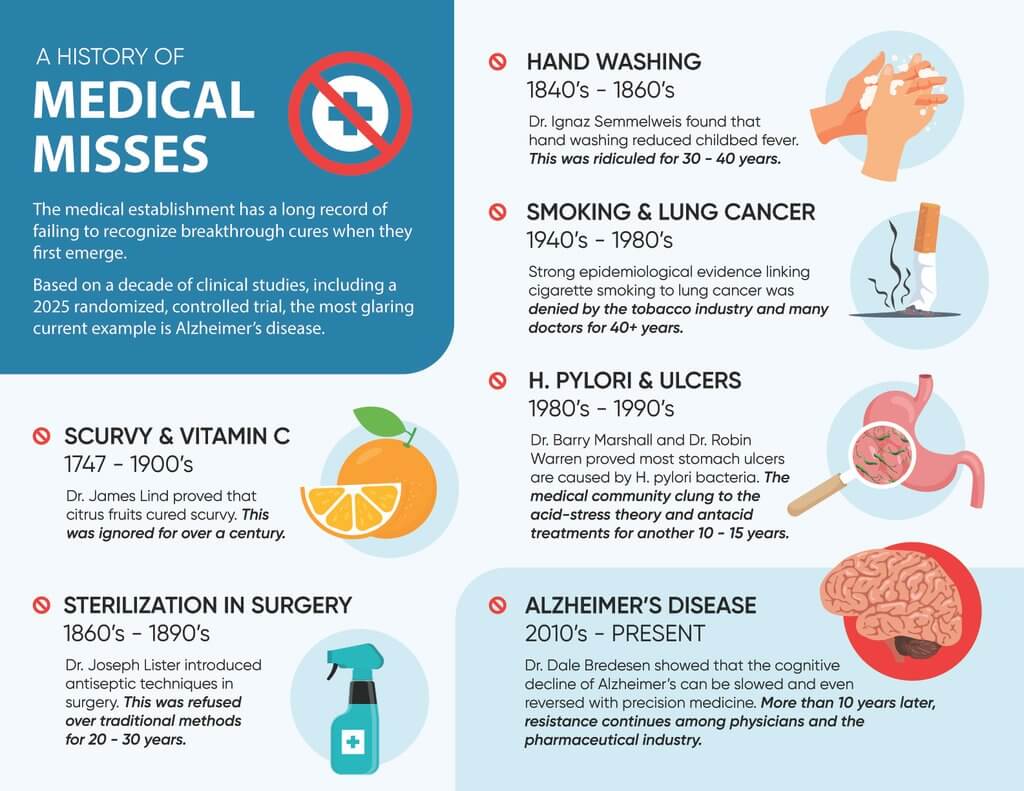
1. Scurvy and Citrus: A Century-Long Wait for Limes
In 1747, Scottish naval surgeon Dr. James Lind conducted what is widely recognized as one of the first controlled clinical trials. He proved consuming citrus fruits could cure scurvy, a common and debilitating condition for sailors. The establishment’s reaction? It ignored his findings for over a century. Tens of thousands of seafarers continued dying from agonizing connective tissue collapse simply because naval brass couldn’t fathom that a couple of limes would solve the problem.
2. Hand Washing: ‘Gentlemen Doctors Do Not Have Dirty Hands’
In the 1840s, Viennese obstetrician Dr. Ignaz Semmelweis noticed that new mothers whose babies were delivered by doctors coming straight from autopsy rooms had catastrophic death rates from childbed fever. When he instituted simple hand washing with a chlorinated lime solution, maternal mortality plummeted.
Instead of throwing him a parade, the medical elite were deeply offended. The prevailing belief was that a gentleman’s hands were inherently clean, and how dare anyone suggest they were spreading invisible death? Semmelweis was professionally ostracized, ridiculed for 30 to 40 years, and eventually died in an asylum —ironically succumbing to an infection.
3. Sterilization in Surgery: Keeping the Germs Fresh
Two decades later, in the 1860s, Dr. Joseph Lister introduced antiseptic surgical techniques. He argued that sterilizing surgical instruments, washing wounds, and keeping operating theaters clean dramatically prevented post-operative complications like gangrene and sepsis. Traditionalists balked, refusing his protocols for 20 to 30 years because real surgeons were supposedly distinguished by the crusted, dried blood caked onto their coats.
4. Smoking and Lung Cancer: Sponsored by Your Family Doctor
By the 1940s, epidemiological data linking cigarette smoking to lung cancer was mounting rapidly. The medical community’s response was to spend the next 40 years looking the other way while medical journals ran glossy spreads declaring that ‘More doctors smoke Camels than any other cigarette.’ It took until the 1980s for conventional medicine and public health regulators to stop hedging their bets and tell the public what the data had shown for nearly half a century.
5. Ulcers and H. Pylori: The Great Spicy Food Fallacy
Until the 1980s, every gastroenterologist knew with absolute certainty that stomach ulcers were caused by high stress, bad temperaments, and spicy food. When Australian physicians Dr. Barry Marshall and Dr. Robin Warren demonstrated that ulcers were actually caused by Helicobacter pylori bacteria, the gastroenterology community scoffed. Big Pharma was busy selling billions in antacids, after all. Dr. Marshall famously grew so tired of waiting for the establishment to listen that he cultured the bacteria, swallowed a beaker full of it, gave himself acute gastritis, and cured himself with antibiotics. Even with that dramatic display, the medical world clung to the ‘acid-stress’ dogma for another 10 to 15 years before finally conceding that antibiotics were the actual cure.
Enter Alzheimer’s: The Medical Establishment’s 40-Year Trap
Today, it is easy to smirk at the backwardness of Victorian doctors or 20th-century ulcer specialists. But the medical establishment has not suddenly become immune to dogma. The most glaring current example is happening right in front of us: the management of Alzheimer’s disease and cognitive decline.
For four decades, mainstream neurology has operated on a rigidly reductionist assumption: Alzheimer’s is a single disease caused by the buildup of sticky amyloid plaques, and the solution must be a single ‘silver bullet’ drug that clears those plaques out of the brain.
The result of this single-minded obsession? Over 400 failed clinical drug trials, hundreds of billions of dollars incinerated, and a clinical failure rate hovering above 99%. While some have hailed lecanemab or aducanumab for clearing amyloid plaques, participants did not suddenly recover on these drugs. Rather, they experienced a slightly reduced rate of decline in exchange for the risk of brain swelling and micro-hemorrhages.
The Paradigm Shift: Fixing the Roof, Not One Shingle
In 2014, Dr. Dale Bredesen started disrupting this stagnant consensus by asking a fundamentally different question: What if amyloid isn’t the root cause of Alzheimer’s at all, but rather the brain’s protective downstream reaction to a toxic, inflammatory, or nutrient-starved environment?
Dr. Bredesen developed what is known as the Bredesen Protocol, operationalized and delivered through Apollo Health’s ReCODE program. Instead of searching for a magical single bullet, the Bredesen Protocol uses what Dr. Bredesen calls “silver buckshot.”
Think of Alzheimer’s as a roof with 36 distinct holes:
- Insulin Resistance: The brain loses its ability to utilize glucose efficiently, effectively starving neurons of vital energy (often termed ‘Type 3 Diabetes’).
- Chronic Systemic Inflammation: Driven by stealth oral/gut pathogens, chronic infections, leaky gut permeability, or inflammatory diets.
- Trophic & Hormonal Deficiencies: Critical drops in nerve-supportive factors—including BDNF, vitamin D, thyroid hormones, progesterone, testosterone, and estradiol.
- Environmental Toxicants: Exposure to heavy metals (mercury, lead), chemical biotoxins, and mycotoxins from mold that trigger neuro-defense mechanisms.
ReCODE analyzes all 36 potential contributors, finds which ones are breached in an individual’s unique biology, and systematically patches them together.
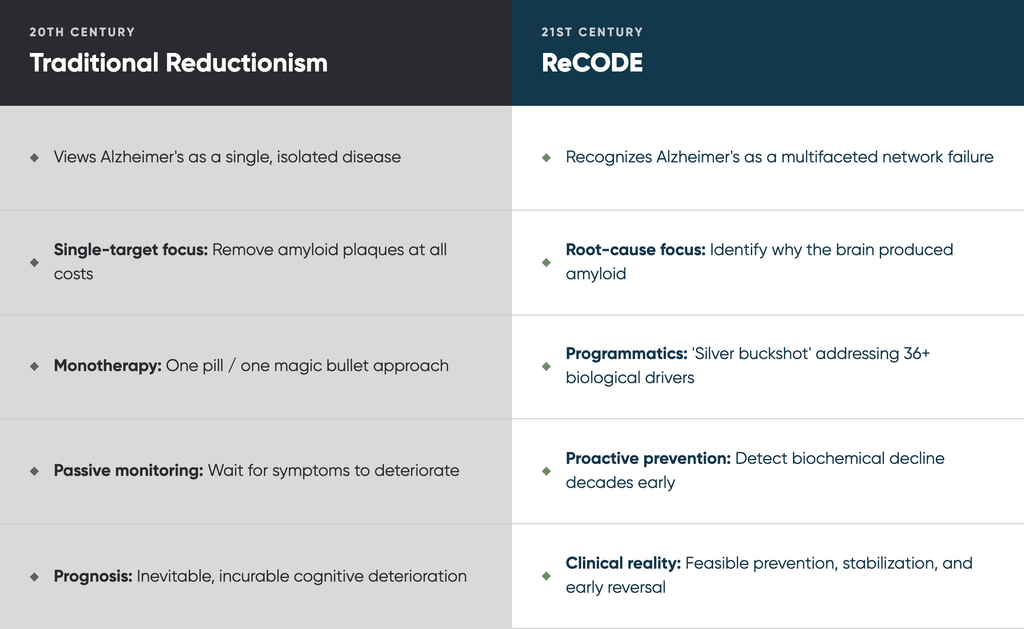
The Establishment’s Reluctant Acknowledgment
When Dr. Bredesen first published peer-reviewed studies documenting unprecedented reversals in cognitive decline, the initial reaction from academic gatekeepers was right on cue:
- “It’s too complicated to test in a conventional trial.”
- “You can’t treat people with nutrition, sleep, and lifestyle changes; that’s not how drug development works.”
- “Those patients probably didn’t have real Alzheimer’s anyway.”
It was Semmelweis and H. pylori all over again. Institutional Review Boards routinely rejected multi-variable protocols because clinical trials were designed to test one variable at a time. Human biology, unfortunately, does not run on single variables.
Fast forward through more than a decade of evidence building, first with case studies and then peer-reviewed clinical studies—including a landmark randomized controlled trial demonstrating objective, measurable improvements in cognitive scores and brain volumetrics—and the wall of resistance might finally crack. Thousands of trained physicians and tens of thousands of participants worldwide are documenting that cognitive decline can not only be slowed but halted and reversed.
We are currently watching the establishment transition from step 1 (‘It’s impossible’) to step 2 (‘It’s too complicated’). Step 3 (‘Of course metabolic and precision health preserves cognition, we knew it all along’) is coming; we just don’t know when.
Don’t Wait for the Consensus to Catch Up
If you had waited for the British Navy to officially mandate limes, you would have spent a century dying of scurvy.
When dealing with something as precious as your mind, waiting decades for institutional consensus isn’t just inefficient—it’s reckless.
The science has already shifted. Cognitive decline is not an unavoidable curse written into your genetics, nor is it an impenetrable mystery that only a multi-billion-dollar prescription can touch. Through comprehensive evaluation, targeted biotracking, and personalized interventions, The Bredesen Protocol and ReCODE are helping people protect their brains and reclaim their lives right now.
The establishment will eventually join the party—they always do. But there’s no reason your brain should wait around for their permission.



October 15, 2026•Core Components, Insider Strategies, News
Early Detection: The Advantages of p-Tau 217 and the BrainScan Test