April 16, 2026
The Tools to Optimize Outcomes for All of Us

By Dale Bredesen, M.D., Chief Scientific Officer for Apollo Health
Everywhere you look today, from Instagram to X to your email Inbox, you see the 3 trends: GLP-1, anti-aging, and brain health. Every day, we hear about some crystal you are supposed to put on your forehead for a miraculous recovery, or a new injection with minimal data but a maximal price tag, or a “master class” taught by a “master” who has published nothing. Some mouse turns right instead of left in a maze, and immediately the headlines are “New Breakthrough in Alzheimer’s Treatment” — but we all know that it’s just not that easy, and there have been dozens of promising Mouzheimer’s treatments that have not panned out in human trials. Unfortunately, most of what we hear about brain health today is more about advertising than it is about optimal outcomes.
My laboratory group and I have worked on neurological disease and brain health since 1989, always focused on improved understanding leading to optimizing outcomes, so I think it is a propitious time to describe the many systems and procedures we have put in place to help everyone to have easy access and achieve best outcomes, whether for enhancing normal cognition, or prevention, stabilization, or reversal of cognitive decline.
We have worked with the Apollo Health team including Lance Kelly (formerly of Apple) chief executive officer, Sho Okada director of program management, Julie Gregory role model and chief health liaison, Dr. Ram Rao principal research scientist and ayurvedic physician, Christine Coward vice president of coaching, Dr. Aida Lasheen consultant, and the outstanding team Lance has assembled to translate our decades of laboratory findings, to create and curate the many essential features in order to enhance cognition for all of us:
1) Cq Assessment
We can all see where we stand with a free online cognitive assessment (cognitive quotient, Cq). This is particularly important because cognitive decline can sneak up on us, and our physicians often ascribe it inaccurately to “normal aging.”
mycqtest.com
2) BrainScan
We can get a precise look at our ongoing brain biochemistry with new blood tests, p-tau 217, GFAP, and NfL. We have evaluated the several different labs performing these, and the one with the greatest validation and most sensitivity is from Neurocode, which also provides an explanatory report. Checking this test every 5 years is simple and, just as hemoglobin A1c will warn us before we develop diabetes, BrainScan will warn us long before we ever develop significant cognitive decline, so that the vast majority of us can avoid dementia — what a welcome change from past practices.
BrainScan
3) Cognoscopy
For everyone who is 35 or over, just as it’s important to know our blood pressure and lipids, it’s also important to know our risk factors for cognitive decline, especially since recent research has shown that brain changes that ultimately lead to dementia may begin in our 20s or 30s. There is so much we can all do to avoid cognitive decline, and the ReCODE labs complement the Neurocode biomarker labs — the latter show IF there is ongoing pathophysiology, whereas the former show WHY, i.e., what factors are actually driving the decline or risk for decline. You can get these labs, many of which are not ordered by standard-of-care physicians, along with an explanatory report.
Mycognoscopy.com
4) ReCODE Report
Each of us should know our risk for developing cognitive decline, what to do about it, and the progress we are making toward a life without concern for dementia. These are all provided in the ReCODE reports generated from the lab values and the historical questions. We developed these based on the lab research we performed over 30 years, revealing the key mechanisms of neurodegeneration.
ReCODE Report
5) Informative & Valuable Resources
Many people have specific questions about their own unique situations or new products or clarifications or simply want to keep up with the latest developments, so we have set up both monthly Town Halls and human staff (not robots) to answer all of your questions, and help everyone to get pointed in the best direction. In addition, there are forums to share information, and over 100 guides — from what to do about general anesthesia to dealing with mycotoxins to how best to measure ketones to when to use CGM (continuous glucose monitoring) to why the KetoFLEX 12/3 diet is so effective and on and on, all to optimize outcomes for every one of us.
6) ReCODE 2.0 Training for Practitioners & Coaches
We have found that the vast majority of practitioners — from physicians to neuropsychologists to nurse practitioners to physicians’ associates to nutritionists to health coaches and others — do not have the knowledge or expertise to reverse cognitive decline, and therefore, we created ReCODE 2.0 training. Well over 2000 physicians — from all over the US and 10 different countries — have now taken this training, as well as many other practitioners, and many are achieving excellent results with their patients — patients who have often been told by other physicians that there is no hope for improvement, yet time and again achieve this with the ReCODE protocol. It is easy to find a well-trained practitioner near you on the Apollo Health website.
ReCODE 2.0 Training
Find a Practitioner or Coach
7) ReCODE 2.0-Certified Coaches
There is an extensive and outstanding cadre of health coaches at Apollo Health, providing training, support groups, and optimization of outcomes.
Health Coaching
8) Data Proven
The many people who have adopted the ReCODE protocol are helping to improve outcomes for everyone: their testing and cognitive outcomes provide a large and growing data set, with more examples of reversal of cognitive decline than any other group in the world. These data will allow AI analysis to continue to improve outcomes. We have used these data to prove that the protocol improves depression (https://www.mdpi.com/2076-3425/16/1/2 ), to determine the frequency of positive outcomes (https://pubmed.ncbi.nlm.nih.gov/34680464/ ), and in ongoing work to show that, unlike in drug trials, in which the high genetic risk group ApoE 4/4 typically has the poorest outcome and the most severe side effects, ApoE 4/4 individuals do very well on the ReCODE protocol (Rao et al., manuscript in preparation).
9) Key Partners
It is essential for all of us to know what works and what does not — what is hype and what offers real, data-driven hope. Therefore, we have curated the best-in-class for each test and instrument — most of which are available at reduced cost through the Apollo Health website — such as the Neurocode BrainScan test mentioned above, the photobiomodulation devices from Vielight and Neuronic, the superb supplements from Life Seasons, the KetoFLEX 12/3 delivered meals from Trifecta, and many others.
10) Technology-enabled personalization and engagement
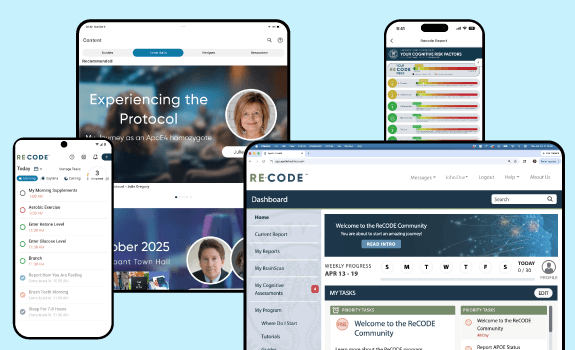
Of course, none of this is helpful if it is difficult to follow or impossible to track over time, so we have worked to bring everything together into a simple, unified system. Through the Apollo Health platform and mobile tools, each of us can see our results, track our progress, and understand how the many pieces fit together, while devices such as glucose and ketone monitors, sleep and activity trackers, and other technologies provide a continuous view of what is happening day to day. Instead of relying on occasional snapshots, we can now follow trends, see what is helping, and make thoughtful adjustments along the way. In this way, technology becomes not a distraction, but a quiet partner — helping each of us stay engaged, informed, and steadily moving toward better outcomes.
11) The Future of Assisted Living
As a neurologist, I have watched for decades as those with cognitive decline entered assisted living facilities and quickly accelerated their decline. It is heartbreaking to see patients who no longer recognize their families. Several years ago, Dr. Heather Sandison, one of the early ReCODE trainees, created Marama, the first assisted living facility to offer the ReCODE protocol. To document stabilization and improvement in the residents was a first, and although Marama is now history, a much larger facility with over 400 residents has been established at The Vineyards, led by Dennis Bacopulos, chief executive officer. This is the future of assisted living, with preserved cognition and much happier family interactions.
The Vineyards
Most importantly, Apollo Health has created a community unlike any in the world, one with well-documented and unprecedented cognitive outcomes, one that offers the first hope for those with cognitive decline or risk for decline, and one that continues to advance, helping us all to maintain optimal cognition, be free from the fear of decline, and reduce the societal burden of dementia.