
July 17, 2026
Something Very Interesting is Going On

By Dale Bredesen, M.D., Chief Scientific Officer for Apollo Health
When I was in college, the age of the universe was unknown (of course it was much younger back then!), there was controversy over whether black holes actually existed, and people argued about whether the mind was more than just brain activity — the so-called mind-brain problem. Now we know that the universe is 13.8 billion years old, and we have photos of black holes, but the argument continues about whether our minds represent anything more than the activity of our brains. As a naive college student interested in neuroscience, I thought it was silly to spend time studying whether our minds are anything more than the product of moment-to-moment brain activity — what else could it be? And after all, if there is no brain, doesn’t it seem quite likely that there is no thought process transpiring? However, this debate has been ongoing for thousands of years — at least since the Greek philosophers — and perhaps its most noteworthy argument was made by Descartes, who suggested that the brain is physical but the mind is somehow made up of non-material thought.
Well, a lot has happened since I was that naïve college student, and there is something very, very interesting going on. Observation after observation after observation has shown that our minds must go beyond our brain activity, and the implications are truly jaw-dropping. Here’s one of many examples: Pam Reynolds was a woman who had a massive aneurysm in her basilar artery (which supplies parts of the brainstem and the posterior cerebral arteries), which could have ruptured and led to her death at any moment. It was considered inoperable, but a famous neurosurgeon named Dr. Robert Spetzler performed a heroic operation, in which he lowered her body temperature to 60 degrees F, stopped her heart and breathing, and drained all of the blood from her brain, in order to shrink the aneurysm. During the operation, she was clinically non-living, without any EEG activity, cerebral blood flow, or brainstem responses. No brain activity — zip. Despite this, when she awoke, she told the surgical team that she had been present at the operation, hovering above the surgical field, and accurately described the instruments used, conversations, music played during the operation, and even the exact pitch of the drill (she happened to have perfect pitch). Furthermore, she said that the surgical team “thought I was that thing on the table” rather than herself, hovering and watching the entire procedure.
There are now hundreds of examples, and entire books written, about situations in which the brain and mind are clearly distinct (check out the story of James Leininger, for example). In our work on neurodegeneration, we are dealing with concrete factors such as infections, toxins, and brain pathology. But the success in treating cognitive decline has come from not ignoring key observations over the years, and deriving a model that fits the various ostensible paradoxes that have arisen from the many thousands of published papers. We must likewise consider the implications of the unexplained observations about mind-brain duality. And this is where things become truly fascinating.
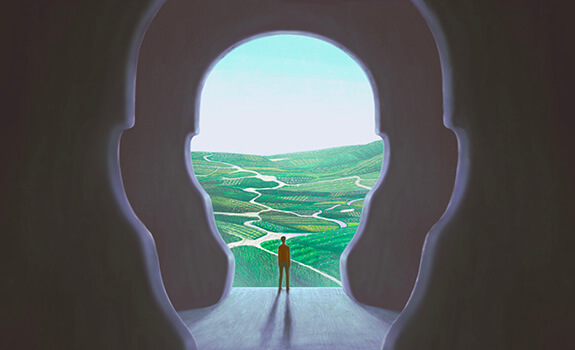
It is clear from the many reports that brainspan and mindspan are not the same — that although the brain ends with our death, the mind does not. Another repeated observation is that the mind can wander physically in ways the brain cannot—accurately reporting events that are distant to the body (as Pam and many others have done). The brain is like a computer hard drive, whereas the mind is more like cloud storage, accompanied by a router that generates a wifi signal that can activate the operating system of the brain’s hard drive. It is becoming clear that either the mind will be a new application of the physical principles we already understand, such as electromagnetism, or it will involve new physical principles, ones of which we are not currently aware — either way it turns out, it will have fascinating implications for our survival, interactions, future, religions, and the fundamental nature of our being.
It is, of course, easy to be skeptical despite the many unexplained observations that separate the mind from the brain, and I would challenge anyone to come up with an explanation for these repeated observations that does not split the two entities. As we understand the principles of the mind better, it is becoming apparent that we are indeed far more than our physical bodies, far more than our laboratory values and synaptic connections. We need much more innovative research on the mind, for as remarkable as the brain and its workings are, the potential we shall unlock by understanding the mind is truly, well, mind-blowing.