
July 13, 2026
Back to Basics: Remember the Bredesen Seven


By Julie Gregory, Chief Health Liaison for Apollo Health
“Summer’s here, and the livin’s easy.” But is it really?
For those who have recently begun following the Bredesen Protocol, it can feel anything but easy. Depending on your starting point, your familiar ways of eating and living may need to change dramatically. Even those who have followed the protocol for years can struggle to make all the moving pieces fit together. I get it. Trying to patch more than thirty-six holes in the roof at once — especially while it’s raining — is a daunting challenge.
So, let’s keep it simple.
In this blog, we’ll demystify the “how-to” of the protocol by organizing its foundational principles into the Bredesen Seven — an intuitive blueprint that can gradually become part of your everyday life. The good news is that you don’t need to be perfect. Over time, many people report feeling so much better that these practices become self-reinforcing. Improvements in mood, energy, overall health, and cognition can become powerful motivation to continue.
Before exploring the seven principles, it helps to understand the big-picture thinking behind Dr. Bredesen’s approach. In his model, Alzheimer’s disease develops when the brain’s neuroplasticity signaling becomes imbalanced. As we age and encounter multiple insults, the forces that damage and dismantle neural connections — called synaptoclastic activity — can begin to overpower the forces that build, repair, and maintain them — known as synaptoblastic activity. Over time, the brain may begin to lose connections and function less effectively.
The goal of the protocol is to shift your biochemistry to create the optimal conditions for your brain to repair, function, and thrive. This begins by identifying and addressing the contributors — or potential contributors — to cognitive decline while simultaneously improving the overall health that supports the brain. Nutrition and lifestyle may not always address the primary driver of an individual’s cognitive decline, but they provide the foundation for addressing virtually all of them. That foundation is where the Bredesen Seven begins.
Embracing the Bredesen Seven
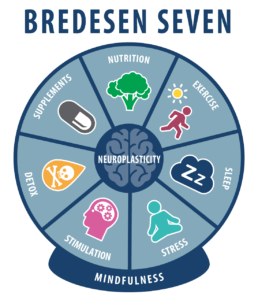
The Bredesen Seven — or B7 — is a simple way to organize the seven core strategies used in the protocol. We’ve all heard that a picture is worth a thousand words. In this case, it may be true.
This image distills what can feel like an extraordinarily complex protocol into seven distinct yet interconnected strategies, all aimed at supporting neuroplasticity — the brain’s lifelong ability to adapt, reorganize, and strengthen or form neural connections in response to experience and other stimuli. Each strategy addresses a different aspect of health, but the real power of the protocol lies in how they work together.
Notice that the wheel rests on a foundation of mindfulness. That placement is intentional. Mindfulness helps us manage stress, remain present, and approach each of the seven strategies with greater awareness and consistency.
A word to those already practicing the protocol: it’s easy to become distracted by the newest —and often most expensive — tools, from EWOT to photobiomodulation devices and beyond. These interventions may be helpful, but they are adjuncts, not substitutes for the fundamentals. No device can compensate for a diet still high in sugar, insufficient movement, inadequate sleep, unmanaged stress, or other neglected basics. You can’t buy your way around the B7. These seven strategies form the foundation of the protocol — and without a strong foundation, the more advanced tools are unlikely to deliver their full benefit.
1. Nutrition: The most effective nutrition plan to support brain health is KetoFLEX 12/3 — a plant-rich, nutrient-dense, whole foods diet that emphasizes local, organic, and seasonal non-starchy vegetables from every color of the rainbow combined with an adequate amount of protein and generous amounts of healthy fat. KetoFLEX 12/3 is a diet that becomes a lifestyle because it also incorporates a long daily fast — a minimum of 12 hours, with at least 3 hours before bedtime. This approach utilizes multiple mechanisms to optimally support the brain to prevent and reverse cognitive decline, including increased energy (via ketosis), reduced inflammation, improved detoxification, metabolic, and vascular health.
2. Exercise: Exercise increases cerebral blood flow and brain-derived neurotrophic factor (BDNF), which has important cognitive support effects. Exercise also helps to improve oxygenation, improve sleep, reduce overall stress, optimize BMI (body mass index), improve insulin sensitivity, and improve overall brain and body physiology in numerous ways. Increase your movement throughout the day. Avoid sitting for extended periods. Incorporate a daily walk, preferably outdoors, and work up to a minimum of 30 minutes. Walk with a purpose, as if you were late to an appointment. Vary your speed and add periods of running as you’re able. Additionally, adopt a strength training program 3 to 4 times per week. Also, consider adding a mind-body practice such as yoga, tai chi, or even ballroom dancing. Exercise is one of the best ways to protect cognition and is also an important part of the protocol to reverse cognitive decline.
3. Sleep: Adopt a sleep hygiene program that allows you to get 7-8 hours of quality restorative sleep every night — without noise, lights, or Wi-Fi. Sleep is vital for memory consolidation and optimal functioning of the glymphatic system to clear cerebral toxins, including amyloid-beta. Additionally, sleep promotes metabolic health, reduces inflammation, and upregulates the immune system. Obstructive sleep apnea and other causes of reduced oxygenation are emerging as important risk factors for poor cognitive health. Rule these out by checking your nighttime oxygen saturation, which can be done with a continuous pulse oximeter. If you are found to have sleep apnea, continue periodic monitoring to ensure that your treatment is effective.
4. Stress: Stress, especially chronic, unresolved, or severe stress, may be a key contributor to cognitive decline. While stress is unavoidable, you can learn to control your reaction to it. We encourage you to adopt a daily stress management practice that could include any of these: mindfulness, meditation, Neural Agility, Dynamic Neural Retraining System, HeartMath, prayer, tai chi, qigong, or yoga. Additionally, you can build daily stress management habits that include time for self-care, not over-scheduling, using lists, unplugging from technology, avoiding multitasking, exercising, and getting adequate quality sleep.
5. Brain Stimulation: It’s important to stay mentally active, to “upsize” our brains. Our brains continue to develop new neurons throughout our lives in response to social and mental stimuli to aid in healing from trauma or injury. You can upregulate this by maintaining healthy senses, staying socially active, building a support system, having a strong purpose in life, and engaging in lifelong learning opportunities. Additionally, even simple pleasures like listening to music and dancing can help to promote new neural pathways. Consider daily brain training to keep your brain challenged. Use BrainHQ or any similar program. Your goal is to work up to 90 minutes per week. Keep it fun and challenging with short daily sessions (12 to 13 minutes) per day, or if you prefer longer sessions, you can engage in three (thirty-minute) sessions per week.
6. Detox: Avoidance of “dementogens,” chemical agents that impact our cognition, is a vital part of optimizing brain health. Ensure that the air you breathe, the water you drink, the home you live in, the food you eat, and the toiletries, cosmetics, and cleaning supplies that you use are as toxin-free as possible. It’s especially important to avoid exposure to mold, which is turning out to be a major contributor to cognitive decline, especially in genetically susceptible individuals. Additionally, practice good hygiene to reduce inflammation and maintain intact internal barriers (gut lining, blood-brain barrier, oral and nasal) as well as external barriers (skin, nails, and hair). Oral health of your teeth, mouth, and lips is emerging as an important opportunity to intervene and protect your cognitive health, especially if the presence of mercury is high from dental amalgams, you experience frequent cold sores or have any of the signs of gum disease.
7. Supplementation: Supplements are supplemental, but if you’re suffering from a specific nutritional deficiency that affects your cognitive health, they can be a very important contributor to healing. In fact, Dr. Bredesen has specific biomarker goals for the nutrients that are necessary to optimize brain health. Given your unique genetics, level of stress, and other environmental impactors, your need for supplementation may change over time. In general, we find that the longer people practice the protocol — combining a nutrient-dense diet with a healing lifestyle — their need for supplementation decreases.
Next time the protocol feels overwhelming, remember the B7. You needn’t focus on complicated roof repairs. Simply come back to seven complementary strategies — a different way of eating, living, and being — that work together to optimize overall health and support cognition.


June 19, 2026•From Julie Gregory, Insider Strategies, News